
How to Finish Seams Neatly Without an Overlocker
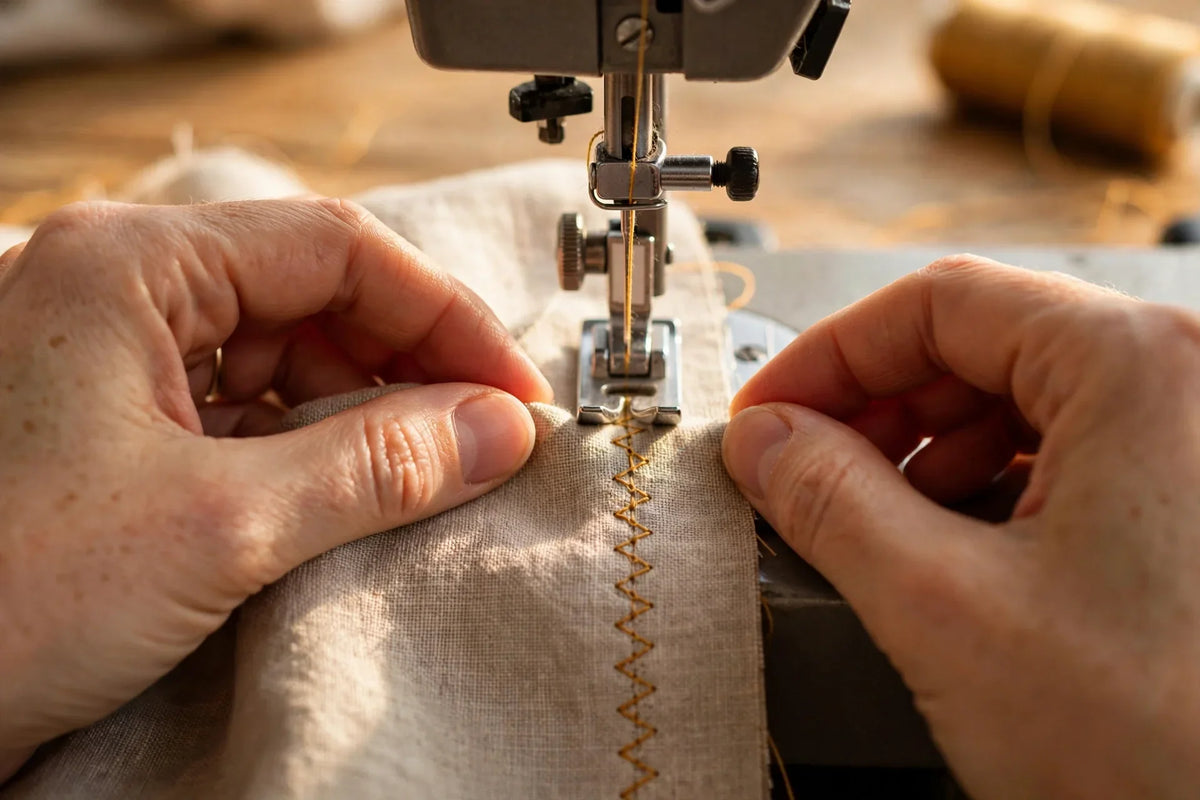
My most-watched TikTok (569,000 views) is a dupatta hem I sewed with a tiny presser foot! The comments are full of people who've owned that foot for years and never knew what it did. Do you need an overlocker to get the same result? No, you don't. You have four options: a zigzag stitch and a close trim, pinking shears, French seams, or the rolled-hem foot for dupattas. I've sewn all four of these methods on a home machine. The rolled-hem foot finishes a dupatta edge in one pass.
The zigzag method you'll use most
Set the machine to zigzag, width 3 to 4 and length 1.5 to 2. These are the exact settings I use on my Singer. Sew along the raw edge so the needle swings just off the fabric on the right swing, and the thread wraps the edge like a little cage that holds the fraying in. Then simply trim close to the stitching with sharp scissors because the trim is the crucial step. But on a salwar's inside seams, this finish lasts for years and the dotted zig-zag gives an even prettier finish.
In my book I use it for filling salwar cuffs. Half the pieces in Punjab are finished exactly this way, and I don't think the overlocker is a requirement. So if you only learn one finish, make it this one. The zigzag is my go-to for everyday seams. That's the whole method.
Pinking shears
Pinking shears are zigzag-edged scissors. Cut the raw edge and the little teeth slow the fraying dramatically and at about 30 seconds a seam nothing beats it for speed. But don't trust them on cloth that frays aggressively, like a loosely woven lawn. Think of it as good, not permanent.

French seams for see-through fabric
For chiffon and sheer lawn where the inside of the garment shows through, sew the seam wrong-sides-together first with a narrow 6mm seam allowance. Trim it back, press, then stitch right-sides-together so the raw edge is enclosed completely. No raw edge anywhere! It looks tailor-made because frankly it is the tailor's method.

The rolled-hem foot trick (piko)
This is that video, the one from TikTok, where a rolled-hem foot curls the fabric edge under itself as you sew, giving you a narrow 3mm hem in one pass. That's the classic dupatta piko. And the foot does the curling for you. The trick everyone misses is how you feed it: feed the first 5cm by hand, twisting the edge into the scroll and keep the fabric moving into the curl, not away from it so don't skip the 30cm scrap practice. Your fifth attempt will probably look store-bought, and your first will look like a crime, which is normal.

Which finish for which seam
Not sure which finish to reach for? The thing is, the fabric decides, not you. Salwar inner seams get zigzag and trim. I'd start there. For kameez side seams in lawn, go French if the fabric is sheer and zigzag if it's opaque. Dupatta edges get the rolled-hem foot and for jeans just zigzag. Denim forgives everything, and these are the finishes I teach!
The bound finish for the fancy inside
For an unlined jacket or a kameez meant to look immaculate inside, reach for bias binding. Wrap a strip of bias tape around the raw edge and stitch it down. It'll take longer — maybe 20 minutes a seam — but the inside really comes out looking like a boutique garment. I save this finish for gifts, and only gifts. When someone turns the garment inside out to admire the work, bound seams are the flex.
Ready to put neat seams on a real garment? Stitch the Salwar walks you through a full salwar, measuring, cutting, stitching and finishing, for $79, with lifetime access.
Neat insides are the difference between "I made this" and "I made this." So pick one method and practice it on scraps tonight, and you'll see the difference on the very next garment.
Know someone making a suit? Send them this answer.
Who answered
Gaani
Gaani teaches you to measure, draft, cut and stitch a Punjabi suit — in Punjabi, step by step, filmed at her own table.
Questions about this answer